
Perturbation-Based Balance Training Equipment: 5 Essential Devices for Patients
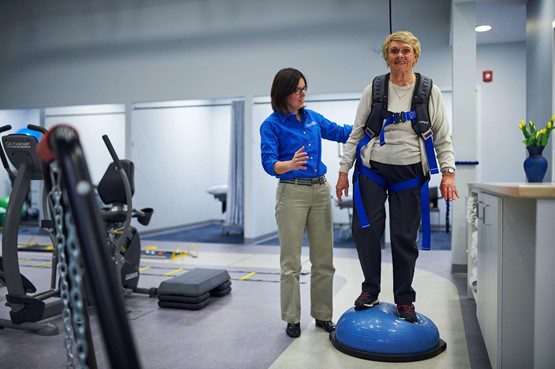
What is Perturbation-Based Balance Training?
Perturbation-based balance training (PBT) is a specialized balance therapy that trains the patient’s body to recover after unexpected and unpredictable balance failures. The patient is exposed to simulated, controlled, sudden movements to trigger rapid, automatic stepping and reflex reactions. Over time, this training helps significantly decrease the chance of the patient falling.
While in a safe, controlled environment, a therapist or specialized machine will introduce balance disturbances, such as:
- Lean-and-release pulls with a harness
- Sudden slips or accelerations on a treadmill
- Platform shifts or tilts that throw the patient off center
By experiencing perturbation-based balance training, the patient’s nervous system learns to adapt to the sudden movements. The goal of perturbation-based balance training is:
- Improve reaction time
- Improve muscle synergy
- Teach the body to take quick & efficient recovery steps
- Improve balance over time
What are the Key Benefits of Perturbation-Based Balance Training?
Perturbation-based balance training can provide many different benefits for patients experiencing balance issues. Some key benefits include:
- Reduced falls
- Improved reaction times
- Decreased fear of falling
- Improved reactive muscle control
- And more
Common Questions Asked About Perturbation-Based Balance Training
How Safe is Perturbation-Based Balance Training?
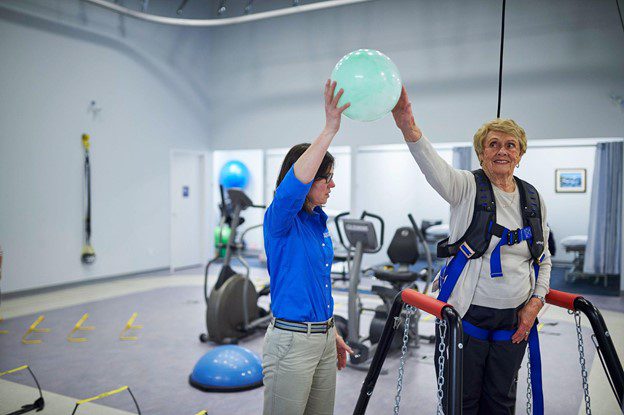
Perturbation-Based Balance Training should only be performed under the direct supervision of a licensed physical therapist. For the protection of the patient and the therapist, the patient should always wear a secure ceiling-mounted safety harness that physically prevents the patient from hitting the ground during simulated slips.
How does Perturbation-Based Balance Training Differ from Conventional Balance Training?
Conventional balance training focuses on static and proactive balance- think standing on one leg or participating in yoga. PBT forces the patient to practice their reactive balance, meaning they learn to recover after an unpredictable balance loss has already happened.
PBT replicates real-life hazards like a slip on ice, tripping over a rug, or suddenly bumping into something. PBT trains the patient’s reactive instincts to increase the chance they will catch themselves when falling.
Is Perturbation Training Safe for frail individuals or older adults?
During Perturbation-Based Balance Training, patients should always be securely buckled into an overhead safety harness system to ensure that they will not strike the ground if they lose their footing or slip and fall from the sudden movements.
While Perturbation Training can be safe for most individuals, it is important for the clinician to carefully control the velocity, acceleration, and directions of the sudden movements. Training should be progressed gradually based on each individual’s tolerance.
Who Benefits the Most from Perturbation-Based Balance Training?
PBT is heavily utilized for individuals with Parkinson’s disease, Multiple Sclerosis (MS), or patients recovering from a stroke to help fix delayed muscle synergies while increasing reaction times.
Geriatric populations also use PBT to reduce their high fall risk.
Sports therapists use PBT to build lower-limb strength while preventing joint injuries during unpredictable cutting or pivoting movements.
5 Perturbation-Based Balance Training Equipment
1. BOSU Balls
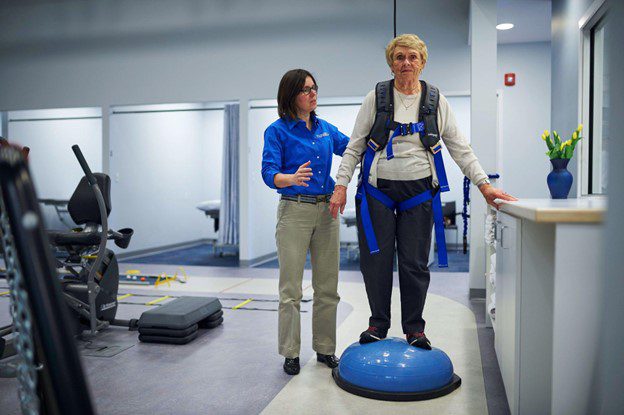
The BOSU Ball’s half-dome design creates constant, multi-directional instability the moment a patient steps on it, forcing the ankle, knee, and hip stabilizers to fire continuously to maintain the center of mass. Because the dome can be used flat-side-up or flat-side-down, therapists can dial difficulty up or down for the same patient across a plan of care.
Why it works for PBT:
- Trains reactive ankle and hip strategies in a low-cost, portable format
- Easy to combine with dual-task drills (ball tosses, reaching, cognitive challenges) to simulate real-world distraction during a balance threat
- Scalable from seated core work to single-leg standing progressions
2. Wobble Boards
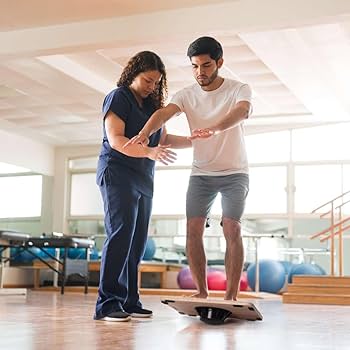
A wobble board sits on a rounded base and tilts in any direction based on the patient’s weight shift, giving 360° of unpredictable instability. Unlike a rocker board (single plane), the multiplane movement more closely mimics the unpredictable nature of a real slip or misstep.
Why it works for PBT:
- Drives feed-forward and feedback postural control adaptations as the patient learns to anticipate and correct tilt in real time
- Builds the intersegmental coordination between the ankle, knee, and hip needed for reactive stepping
- Lightweight and inexpensive, making it easy to use across multiple treatment areas
3. MyoSlide Perturbation Board
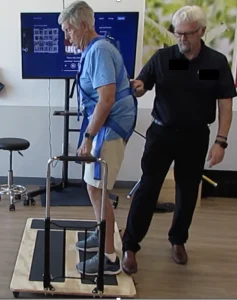
The Myoslide Perturbation Board enables the clinician to address the patient’s specific balance and reaction-training needs and is designed to be safely stored and moved to and from the treatment area. Its sliding/dynamic platform lets therapists apply controlled, direction-specific perturbations rather than relying on a purely random wobble.
Why it works for PBT:
- Gives clinicians precise control over the direction and intensity of each perturbation, useful for targeting a specific movement strategy (e.g., lateral stepping vs. anterior-posterior sway)
- Bridges the gap between simple balance boards and full robotic/treadmill perturbation systems
- Works well for progressive programming, easy to increase challenge as the patient’s Berg or Mini-BESTest scores improve
4. Shuttle Balance
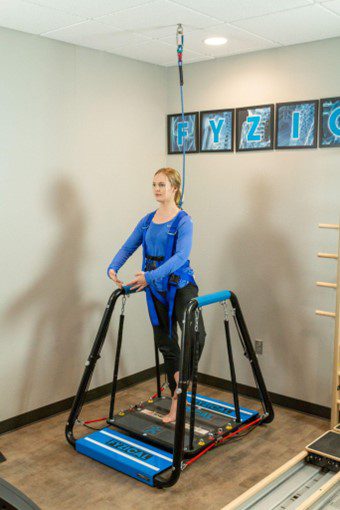
The Shuttle Balance uses adjustable suspension chains to change platform height, degree of stability, and tilt sensitivity, and perturbates in both standing and seated positions for therapeutic and sport-specific treatments. It can also be paired with accessories like a foam pad, DynaDisc, or BOSU ball to stack instability challenges.
Why it works for PBT:
- Simulates real-life slip and balance recovery scenarios with controlled, multi-directional movement, making it one of the more realistic non-robotic slip-simulation tools available
- Adjustability means the same unit works across a huge range of patients, from a frail senior needing minimal motion to an athlete in return-to-sport testing
- Built-in security bars let therapists safely push perturbation intensity higher than a freestanding board would allow
5. Solo-Step Overhead Track & Harness System
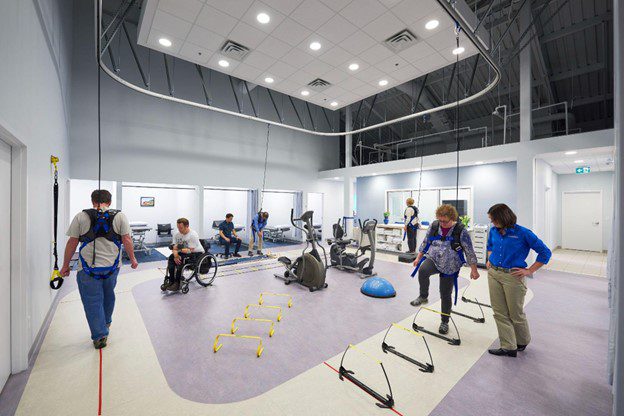
Every device above shares the same limitation: the harder you push the perturbation, the higher the fall risk. The Solo-Step system removes that ceiling by suspending the patient in a harness attached to an overhead track, so a stumble or full loss of balance is caught immediately rather than becoming a fall.
Why it works for PBT:
- Allows clinicians to safely increase perturbation intensity: larger tilts, faster surface changes, bigger reactive-step demands, without hovering to catch the patient physically
- Frees the therapist’s hands to actually deliver the perturbation (manual nudges, resistance bands, unstable surface control) instead of splitting attention between the exercise and spotting
- Enables PBT for higher fall-risk populations who couldn’t otherwise tolerate boards, BOSU balls, or unsupported shuttle systems, expanding who can safely participate in reactive balance training
- Combines with any of the four tools above (BOSU, wobble board, MyoSlide, Shuttle), and more, as an additional safety measure
Choosing the Right Equipment for Safer, More Effective PBT
Perturbation-based balance training only works if patients can be pushed to their real limits, and that only happens when the fear of falling is taken out of the equation. BOSU balls, wobble boards, the MyoSlide Perturbation Board, and Shuttle Board each bring a unique way to destabilize and challenge the nervous system, but none of them can fully protect a patient from hitting the ground. That’s where an overhead track and harness system like Solo-Step comes in, giving clinicians the safety net they need to train harder, progress faster, and open PBT up to higher-risk patients who couldn’t otherwise participate. Whether you’re building out a new balance program or looking to safely increase the intensity of your current one, pairing the right unstable-surface tools with a reliable harness system is the foundation of an effective, fall-reducing PBT protocol.
Ready to see how a Solo-Step system can fit into your clinic’s balance training program?